 AvowedRealm
Fantasy fiction has always been about escape, about being whisked away to realms utterly unlike our own. In 2026, few worlds achieve this with the depth and complexity of Eora, the setting for Obsidian Entertainment's Pillars of Eternity and its first-person successor, Avowed. What makes this world stand out in a crowded genre isn't just its landscapes or its magic, but its foundational mythology—a pantheon of twelve gods who are far more than distant, aloof deities. They are active, flawed, and integral to the very fabric of reality, their conflicts and schemes providing the rich soil from which epic stories grow. For players diving into Avowed today, understanding these divine figures isn't just lore; it's the key to understanding the world itself.
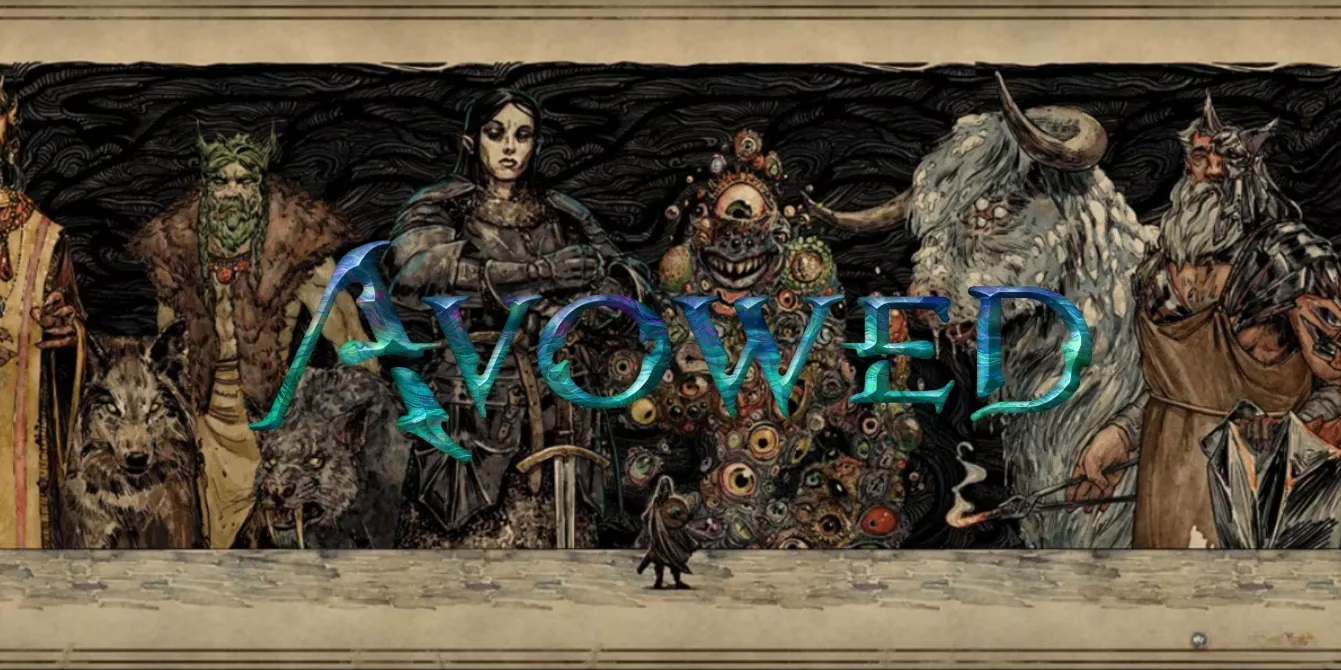
At the heart of Eora's uniqueness is its divine mechanics. The gods reside in The Beyond, an ethereal realm from which they influence Eora's natural cycles. Unlike many fantasy settings where gods are vague concepts, the gods of Eora have distinct personalities, domains, and, crucially, agendas. They are embroiled in politics, betrayal, and cosmic balance, making them feel less like forces of nature and more like the ultimate power players. This setup creates a world where faith, philosophy, and the nature of the soul are not abstract concepts but tangible forces that shape every adventure.
Let's break down this divine roster, because knowing who's who is half the fun (and strategy) of navigating Eora:
| God | Domain | Key Symbolism & Role |
|---|---|---|
| Abydon | Crafting, Industry, Machinery | The divine smith, often forging weapons for Magran. Patron of the Knights of the Crucible. |
| Berath | Life, Death, Cycles, Gateways | Controls "The Wheel" of reincarnation. One of the most pivotal gods for the soul's journey. |
| Eothas | Light, Redemption, Renewal | Works with Berath on The Wheel, guiding souls. Worship is tied to hopes for favorable reincarnation. |
| Galawain | The Hunt, Monsters | The "Father of Monsters," creator of Eora's most dangerous beasts. It's a real "survival of the fittest" vibe. |
| Hylea | Sky, Creative Inspiration | Depicted wrapped in live birds, a muse for artists and innovators across the realms. |
| Magran | War, Fire | The armored goddess of soldiers and explosions. Her priests pack serious heat—literally. |
| Ondra | The Sea, Memory | A tragic figure in love with the moon, her leaps cause tides and tsunamis. A force of beautiful destruction. |
| Rymrgand | Entropy, Decay, Winter | The "Beast of Winter." Not cyclical death, but the final, cold end. The god of things falling apart. |
| Skaen | Resentment, Secret Hatred | "The Quiet Slave," a cowering, ghoul-like god of repressed rage and vengeance from the shadows. |
| Wael | Dreams, Secrets, Illusions | A mysterious cloud of eyes. The god of hidden truths and mind-bending revelations. Talk about an enigma! |
| Woedica | Vengeance, Law, Justice, Memory | "The Burned Queen," exiled but immensely powerful. The goddess of oaths, order, and getting even. |
| Sapadal | The Living Lands | The newest god, central to Avowed, who grants the player-character their Godlike status. A game-changer. |
This pantheon isn't just for show; it's the engine of the plot. The dynamic between Berath and Eothas, managing the cosmic recycling of souls, is a cornerstone of the Pillars of Eernity narrative. Then you have the fallen queen, Woedica, whose exile by the other gods is a foundational event in history, a divine coup d'état that echoes through the ages. Her desire for vengeance and restoration of her old laws creates a perpetual tension. Her relationship with Skaen—often depicted cowering beside her—is a fascinating study in toxic divine hierarchy.
For the modern Avowed player, this lore is more relevant than ever. The game thrusts you into the Living Lands, the domain of the newest deity, Sapadal. Your character's very power as a Godlike is a direct gift from her, making your journey a personal intersection with the divine. This isn't some ancient, dusty mythology; it's active theology. Choosing which philosophies to align with—be it Magran's martial pride, Hylea's creative spirit, or Rymrgand's acceptance of inevitable decay—can shape your approach to the world's conflicts. It's not about being "good" or "evil"; it's about which cosmic principle you find most compelling, or most useful.
Furthermore, the gods' conflicts often manifest in the factions you meet. The Knights of the Crucible, with their iron armbands, aren't just skilled blacksmiths; they're devout followers of Abydon, seeing their craft as a holy act. Understanding this adds a whole new layer to interactions with them. It's this level of integration that makes Eora's world-building next-level. The gods are in the details:
-
Ondra's longing for the moon explains natural phenomena (tides) and catastrophic events.
-
Wael's domain over secrets means that uncovering truth is literally a divine endeavor.
-
Galawain's role means every fearsome beast you encounter is, in a way, a piece of divine art.
In 2026, as games strive for immersive worlds, Eora remains a gold standard. Its pantheon avoids the cliché of simply being reskinned Greek or Norse gods. They are a coherent, interdependent system that answers fundamental world-building questions: Where do souls go? Why do things die? Who made the monsters? The answers are woven into a tapestry of intrigue, making every quest, every discovered text, and every character's faith feel significant. For players of Avowed, taking a moment to learn the gods isn't just homework—it's unlocking the secret language of the world, turning a beautiful landscape into a living, breathing, and divinely contested realm. Now that's how you build a world that sticks with you long after the controller is down.
Comments