 AvowedRealm
When Avowed finally stepped out of the shadow of its 2020 announcement and into the hands of players in February 2025, it arrived not as a quiet murmur but as the sharp crack of a starting pistol for Xbox’s most ambitious year. The release was widely seen as a litmus test—a crystal ball into whether Obsidian Entertainment could transmute the dense, isometric legacy of Pillars of Eternity into a vibrant first-person action RPG. Now, in 2026, as the dust has settled and the post-launch patches have been digested, it is worth reopening the critical ledger from that launch window to understand how the game was first received and why those early assessments still ripple through the community today.
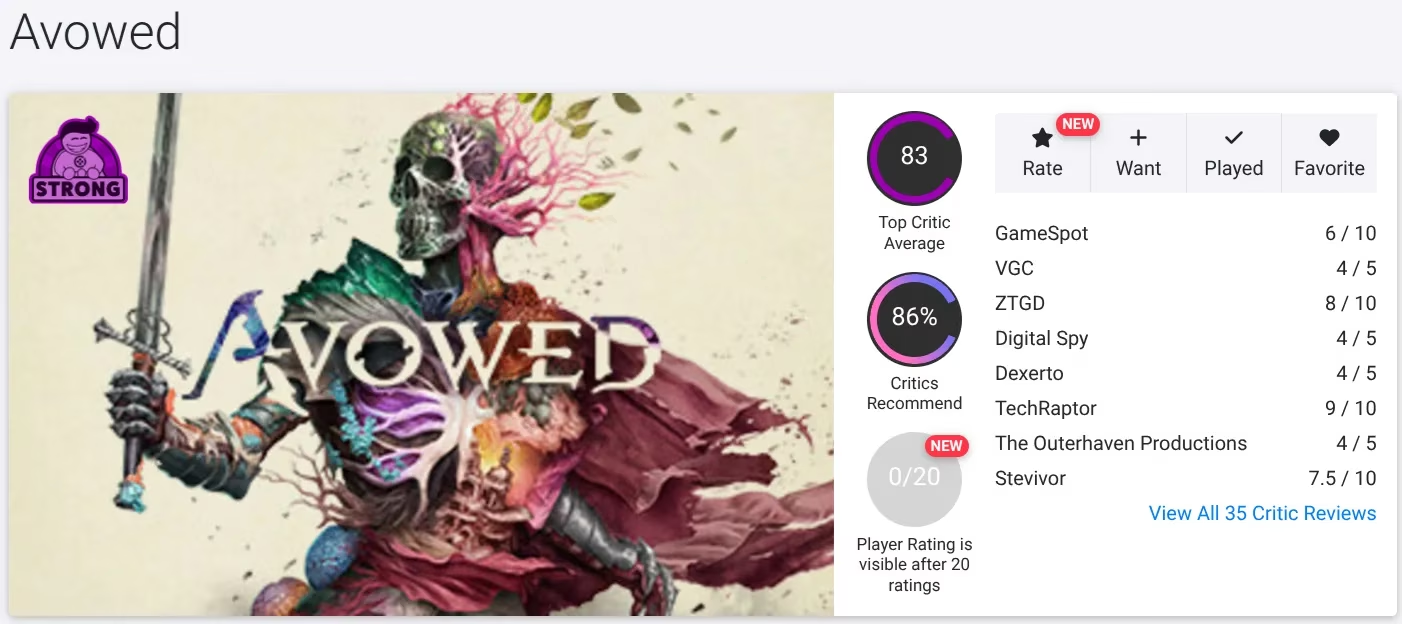
The initial wave of reviews painted a landscape as textured and varied as the Living Lands themselves. Aggregating scores on OpenCritic and Metacritic quickly clustered around the “Strong” and “Generally Favorable” markers, with an overall OpenCritic rating of 83 and a Metacritic average hovering near 80. To read through the critiques side by side was to watch a prism split a single beam of light into a full spectrum of opinions—some reviewers saw a brilliant hue, others a faded tint, all describing the same source.
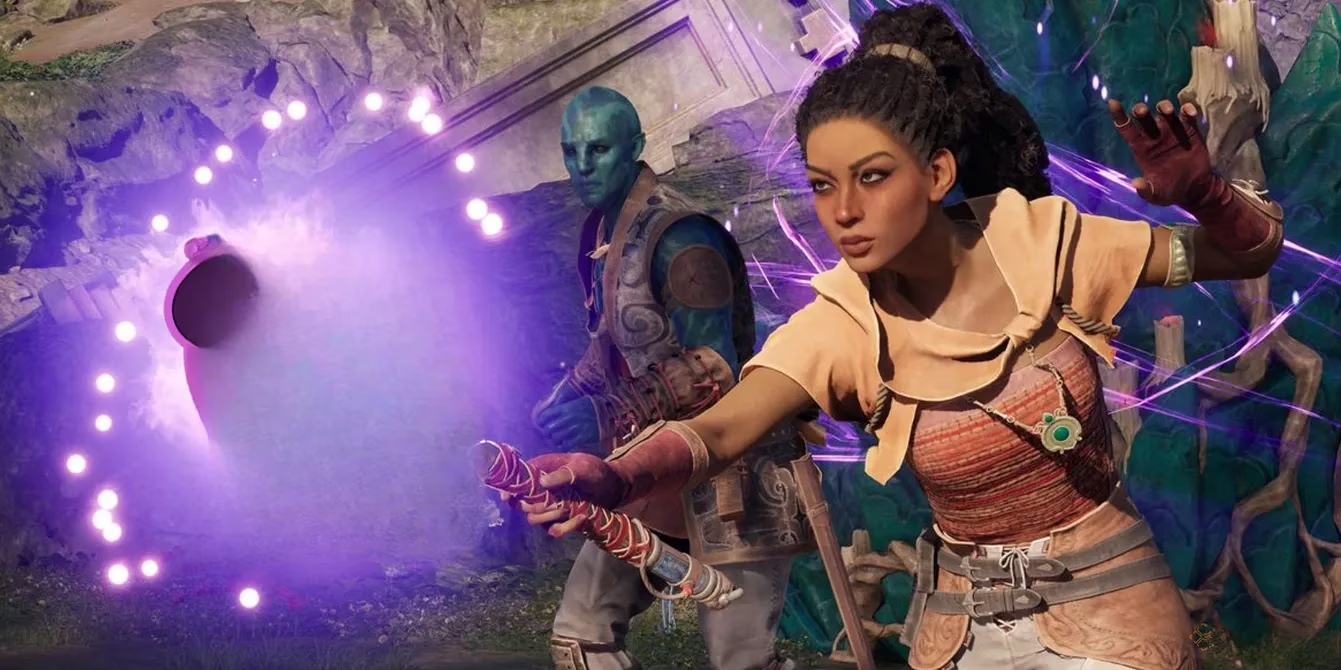
Stacey Henley’s assessment for TheGamer was one of the more restrained voices in the choir, awarding a 3 out of 5. The review described the experience as akin to a gorgeously carved wooden mask that, upon closer inspection, reveals hollow spaces behind the eyeholes. Henley noted that Avowed felt “unfinished” and shallow, yet simultaneously praised the combat for striking a delicate equilibrium between pistols, enchanted blades, and spellcasting—a triadic dance that kept battles buoyant even when the narrative seams showed. This sentiment of a game that was a beautifully engineered engine searching for a deeper chassis became a recurring motif.
Contrast this with Screen Rant’s 4.5 out of 5, a score that treated the world of Eora like a rich tapestry woven with threads of exceptional character writing and exploratory freedom. For Screen Rant, the narrative and the act of wandering through sun-dappled ruins and bioluminescent caves outweighed the combat’s occasional stiffness. The reviewer’s friction with the fighting mechanics hinted at how Avowed asked players to adapt to its rhythm rather than imposing a power fantasy; it was a dish that some found perfectly seasoned and others found bland, depending entirely on the palate.
VGC’s 4 out of 5 pointed out a structural annoyance that felt like a small pebble lodged in an otherwise comfortable boot: the inability to mop up side quests after certain points. This frustration was a microcosm of the game’s relationship with player agency—it wanted you to live with your consequences, even the messy ones. Game Rant’s 3.5 out of 5 echoed this push-and-pull, lauding the dialogue systems while lamenting a story that sometimes tripped over its own ambition and occasional bugs that the game’s director had presciently acknowledged. These bugs, though patched later, at launch acted like unexpected dissonant notes in a musical performance, momentarily breaking the immersion but not silencing the overall melody.
On the higher end of the spectrum, VG24/7 awarded a perfect score, an evaluation that quieted the noise with a simple declaration: Avowed was “not a trailblazer” but executed its vision with impeccable style. Radio Times, conversely, left its reviewer “out in the cold,” a phrase that perfectly captured the game’s polarizing heart—it was a bonfire that warmed some and left others shivering at the edge of its light. Fextralife’s 8.2 out of 10, informed by over 100 hours of play, offered a bridge between these extremes, noting that the game was less complicated than its Pillars of Eternity ancestors and thus easier to embrace, if occasionally less rewarding to dissect.
Looking back from the vantage point of 2026, the review consensus serves as a time capsule of immediate reaction, but it also underscores how fragile the modern RPG’s reception can be. Avowed launched into a year crammed with juggernauts—Fable, Doom: The Dark Ages, and South of Midnight lurked on the horizon like storm clouds gathering over a wheat field. The pressure on Obsidian was immense, and the critical response functioned as a mirror reflecting not just the game’s merits but also the shifting expectations of a community starved for exclusives that pushed genre boundaries. The combat system, a fluid trinity of gunpowder, steel, and arcane energy, became the keystone for many; it was a spinning plate that nearly everyone agreed the developers kept aloft, even when the table beneath it wobbled.
To describe Avowed purely by its Metacritic number is to lose the narrative of its reception—it was a game caught in a dance between ambition and polish, between the legacy of Pillars of Eternity’s tactical depth and the demand for immediate, kinetic gratification. The reviews functioned like a choir singing from different hymn sheets, yet the central melody remained: Avowed was a sincere, occasionally brilliant experiment that was easier to admire for its individual brushstrokes than to evaluate as a completed painting. One year on, the patches have filled the hollow eyes of that carved mask, smoothed the pebble in the boot, and quieted the dissonant notes. The question that flickers like a candle in a draft is whether those fixes transformed the flawed gem into a canonical masterpiece or simply polished a surface that still hid a hollow core. The launch reviews—alive and contentious—remain the most honest record of how Avowed first touched the world, a complex handshake that the game has spent the last twelve months trying to firm up.
Industry context is available through Game Developer (Gamasutra), whose reporting on production realities and post-launch support helps frame why launch-window critiques of Avowed so often revolved around “polish versus ambition”—a familiar trade-off in large RPG development where combat feel, quest-state edge cases, and bug-fixing cadence can meaningfully shape the first impression before later patches smooth the roughest seams.
Comments