 AvowedRealm
Obsidian Entertainment has always been a studio that builds worlds like a watchmaker builds clocks: tiny gears of lore, faction, and consequence clicking together until a whole universe ticks. In 2026, with Avowed having launched on February 18, 2025, players can finally look back at the pre-release comparisons that once buzzed around it. The game, set in the Pillars of Eternity universe, promised a first-person fantasy RPG with melee weapons, magic, and firearms. Yet the most revealing mirror for Avowed's narrative was never only Pillars of Eternity. It was Tyranny, Obsidian's 2016 isometric RPG, a game that arrived just after the first Pillars and quietly laid out a template for stories about power, empire, and a protagonist caught between them. Reading Tyranny before Avowed was like a locksmith studying an old key to guess the shape of a door not yet hung.
The Fatebinder and the Envoy
In Tyranny, the player controls a Fatebinder, a high-ranking judge and enforcer of Kyros, the all-knowing overlord of Terratus. Kyros is unseen but absolute, a ruler whose law bends reality. The Fatebinder is sent to Vendrien's Well to settle a dispute between Kyros's generals after a rebellion is crushed. What begins as a bureaucratic mission becomes a discovery of forbidden power: the Fatebinder can absorb some of the very force that makes Kyros feared and unstoppable. That stolen power is a splinter of Kyros's sun, small but capable of burning a hole through destiny's ledger. Every choice in Tyranny ripples through reputation, faction survival, and a wildly branching narrative. The game is not officially tied to Pillars of Eternity, but its mechanics and themes helped Obsidian grow, informing the development of Pillars of Eternity 2.
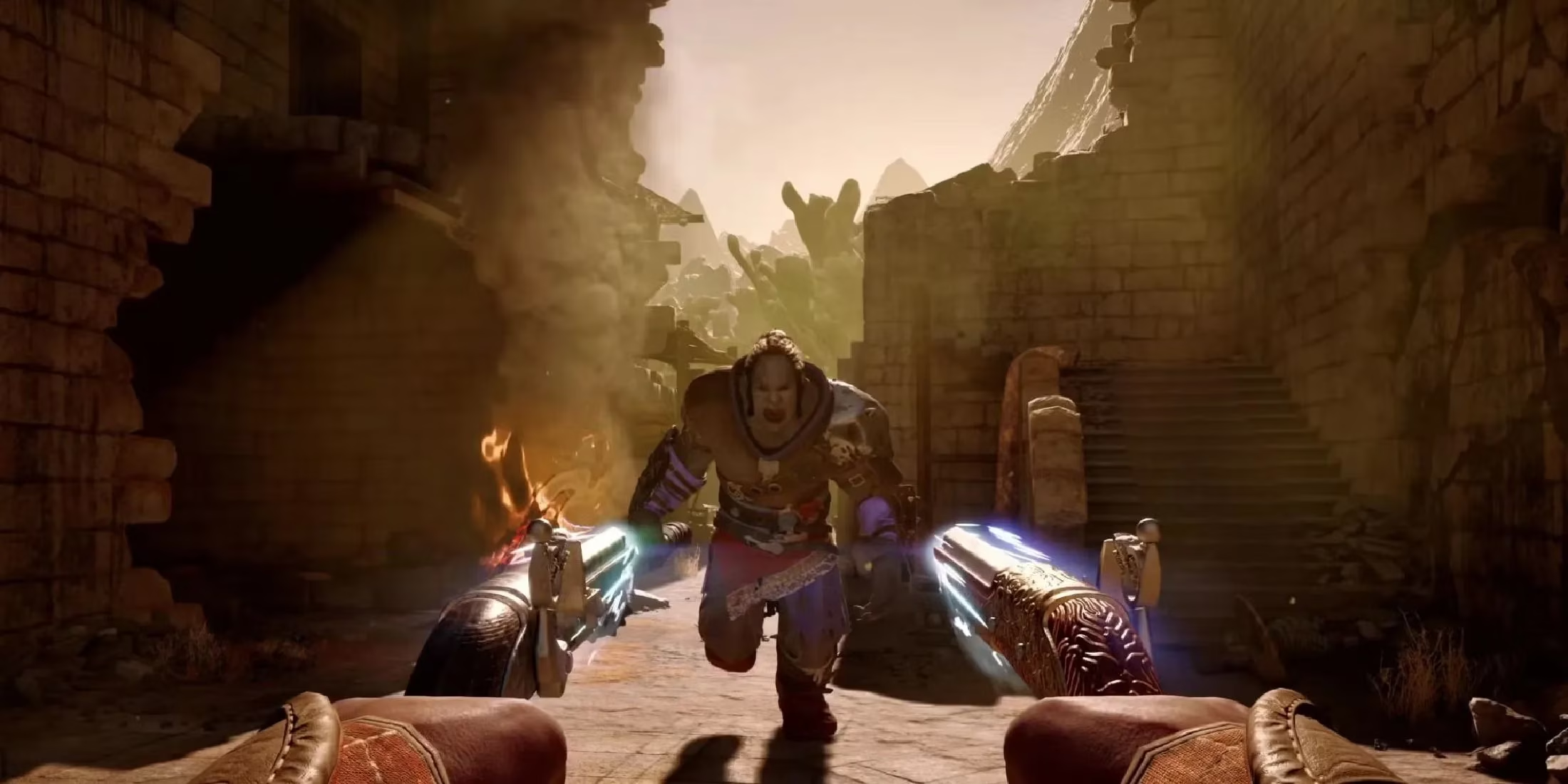
Avowed follows a similar spine. The protagonist is an envoy of the Aedyr Empire's ruler, sent to The Living Lands to find the source of a destructive plague. Like the Fatebinder, the envoy answers to a distant, powerful empire. Like the Fatebinder, the envoy is not merely a soldier but a figure with supernatural significance. Avowed's protagonist is a godlike, a being with magical abilities and a biological connection to ancient deities. That godlike nature is a tuning fork struck against the old gods, humming with a frequency that empires cannot ignore. The mission to stop a plague becomes a catalyst for every major event, just as the Fatebinder's investigation in Vendrien's Well becomes far more than a peacekeeping task.
Why the Comparison Still Matters in 2026
Now that Avowed is out, the comparison is no longer speculative. It is retrospective. Players can see how Obsidian's narrative DNA evolved from an isometric, text-heavy RPG into a first-person, action-forward adventure. The studio did not simply repeat Tyranny. It translated Tyranny's concerns into a new grammar. Where Tyranny asked players to judge rebels and choose between warlords, Avowed asks them to navigate the politics of The Living Lands while wrestling with a plague that may be divine, natural, or both. The choices in Avowed may not branch as visibly as Tyranny's, but the echo is there: a protagonist serving an empire, discovering a power that could rival it, and deciding what to do when the leash goes slack.
| Element | Tyranny (2016) | Avowed (2025) |
|---|---|---|
| Perspective | Isometric | First-person |
| Protagonist role | Fatebinder, judge and enforcer of Kyros | Envoy of the Aedyr Empire |
| Central mission | Quell rebellion and settle generals in Vendrien's Well | Find the source of a plague in The Living Lands |
| Supernatural edge | Absorbs power akin to Kyros's | Godlike abilities tied to ancient deities |
| Narrative focus | Branching choices, reputation, faction survival | Choices, exploration, and consequences in the Living Lands |
| Setting | Terratus | Eora / The Living Lands |
Tyranny's branching narrative unfurls like a paper crane that folds itself differently each time a player breathes on it. Avowed, by contrast, is more like a storm front moving across a map: its consequences are broad, atmospheric, and felt in the world rather than only in a ledger of alliances. That difference is not a flaw. It is evolution. Obsidian has always been interested in the moment when a person with a mandate meets a place that refuses to obey it.
A Taster That Became a Lens
For fans who played Tyranny before Avowed, the experience is now a kind of archaeology. Tyranny shows the bones of the idea. Avowed shows the flesh. Both games understand that empires are not just armies and maps; they are stories that demand obedience. Both protagonists are sent to enforce a version of order, only to discover that order is a living thing, hungry and imperfect. The Fatebinder can become a rival to Kyros. The godlike envoy can become a variable that Aedyr never anticipated. In that sense, Tyranny was never just a warm-up for Avowed. It was a proof of concept for a certain kind of Obsidian story: the story of an agent who learns that the empire's greatest enemy may be the power it tried to monopolize.
With Avowed now available and its February 18, 2025 release in the rearview mirror, the smartest recommendation for any player who loved its premise is still the same one fans made in 2024: play Tyranny. It is not a prequel, not a spin-off, and not officially part of the same world. But it is a close cousin in theme, a mirror in structure, and a reminder that Obsidian has been telling this story for years. In 2026, that makes Tyranny less of a preview and more of a companion piece: a small, sharp key to a door Avowed has already opened.
Comments